

research practices
The collective nature of our research necessitates spanning diverse forms and spaces, our practice is shaped by our research methodologies combined with field-tested heuristics. This results in constantly evolving outcomes that we use in order to provoke further dialogue.

-
Feb 2016
Chennai, India
Crafts and Innovation
University of Maastricht, Kalakshetra
Nov 2018
Chirala, India
Anchoring Innovation
National Federation of Handloom and Handicraft Workers, University of LeidenMay 2022
Berlin, Germany
Responsible Documentation and Conscious Outcomes
Max Planck Institute for History of ScienceAug 2023
Hyderabad /Janagam
Meander Workshop
ERC Penelope Project
-
Sep 2022, Chennai. The metronome and the Count: in music and weavingMusic Academy Research Centre
Apr-Jun 2020
Online
Meetings with Handloom Weavers Co-operative societiesJan 2021Chirala, IndiaHandloom competitionsNational Federation of Handloom and Handicraft Workers, Rashtra Chenetha Jana Samakhya

-
Our textual work has appeared in peer-reviewed and popular media. More information on our published work follows in the section below.
-
Our videos reflect on weaving experiments that produce textiles, relationships and knowledge communities. The videos often have corresponding field notes and legends that document the making process.
-
During COVID lockdowns, Handloom Futures initiated online dialogues between members of handloom institutions including the union, cooperatives, and NGOs.

-
We have exhibited our work in a diverse set of forms and spaces, to move from explication to experience.
gatherings | conferences

-
300 weavers from different parts of India and the world shared a common platform along with professors, activists, policy makers and industry experts, gathered together to discuss the future of handloom weaving, innovation and knowledge sharing.
-
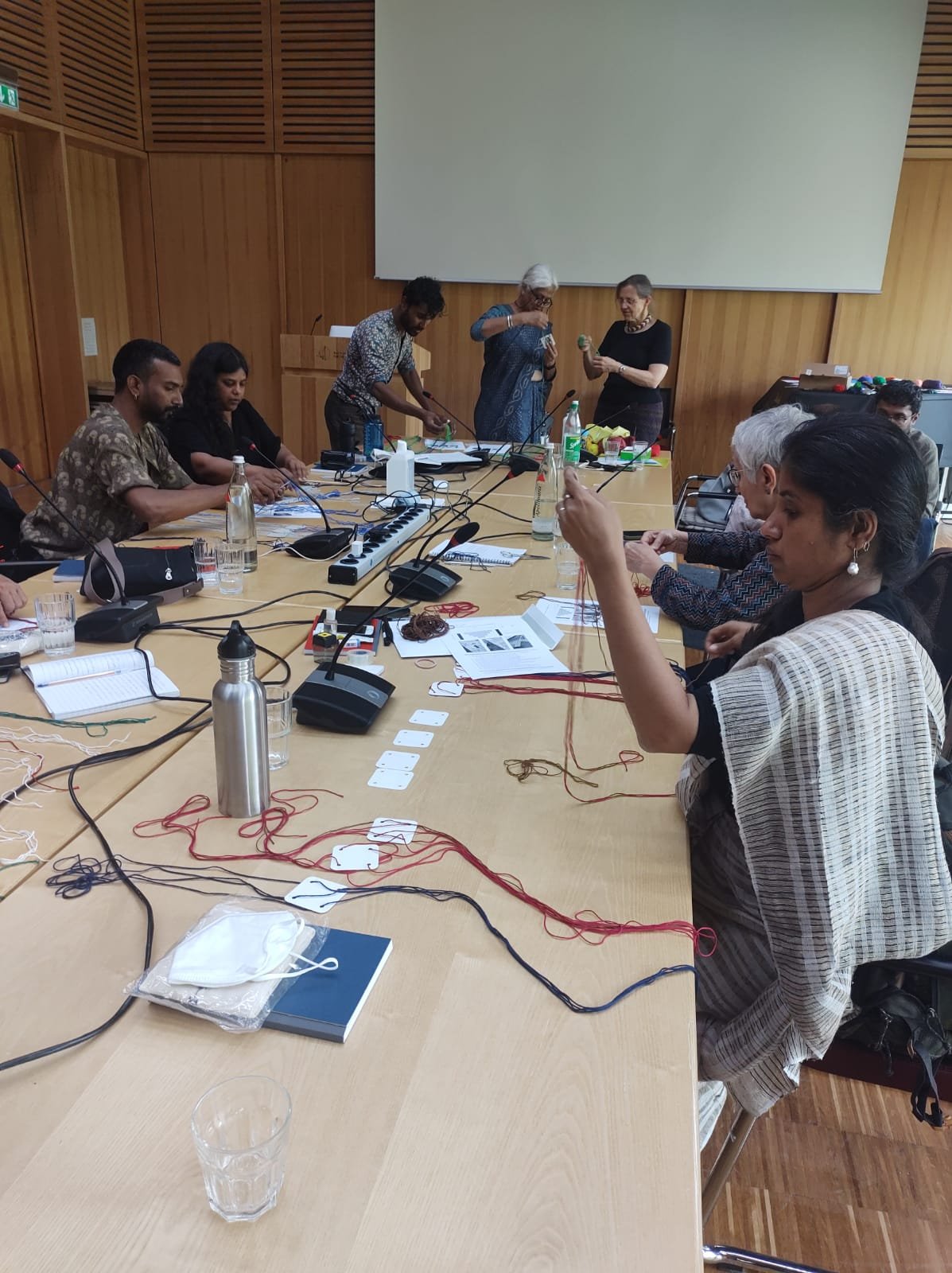
As a reciprocal act to Chirala 2018, this workshop critically reflected on tools that scholars bring, empirics, methods, presences and absences that are pointed to in sharing our skills for them to consider? How would we communicate the craft of research to those who are - by definition of being outside academic practice - not scholars? Would this be one way to think about building new methods and frameworks for responsible documentation and conscious outcomes of mutual benefit to scholars and practitioners?


-
The meander pattern is a key element of the PENELOPE project that investigated the relationship between weaving and mathematics in Ancient Greece. In May 2022, HFT fellows visited the Penelope Lab housed at the Deutsches Museum and funded by the European Research Council. Over a 10 day working group in August 2023, Ellen Harlizius Kluck, the Principal Investigator of the PENELOPE project, and Indian experts including Odelu Vurugonda (HFT) and Dharmender Vaddepalli (Malkha) explored the nuances of the meander pattern as it emerges on a tablet loom, warp weighted loom, and a 12 pedal frame loom .
-
The Craft Origins of Color and its Orderings is a multi-disciplinary workshop taking place at the Historical Dyes Collection and the Colour Theory Research Collection in TU Dresden from Oct 21-23, 2024. The workshop brings together two kinds of colour researchers - natural and chemical dyers from India as well as historians of science and technology from Europe - to build methods and tools for symmetric exchanges between craft, natural and social sciences. Through conducting museum visits to significant sites of material collections, seminars and dyeing demonstrations, the workshop aims to establish the vital role of historical materials and knowledge practices for the future of colour research and craft practices.
gatherings | workshops

-
Handloom Futures organized a tablet weaving workshop for students of the Little Grove at Hyderabad Literature Festival 2023. This 2 hour long hands-on workshop introduced participants to the idea of handling yarn, selecting colours, setting up the loom, manipulating the tablets, designing the desired pattern, and finally, executing the design by weaving it . The workshop explored how textile technology works and enabled participants to explore the role of yarns, colours and design methods in order to create fabric.

-
The idea of ‘orality’ was reflected on and discussed by HFT fellows in multiple sessions. In Carnatic music, orality is known to be embodied in the notion of parampara, represented by guru-sishya relationship. Our reflections on the term ‘orality’ connotes not only parampara but is a method of transmission, a vision of pedagogy which sustains creativity, change and adaptation in a very organic way. Other related ideas like trusteeship of knowledge, role of sadhana, etc were also discussed.
-
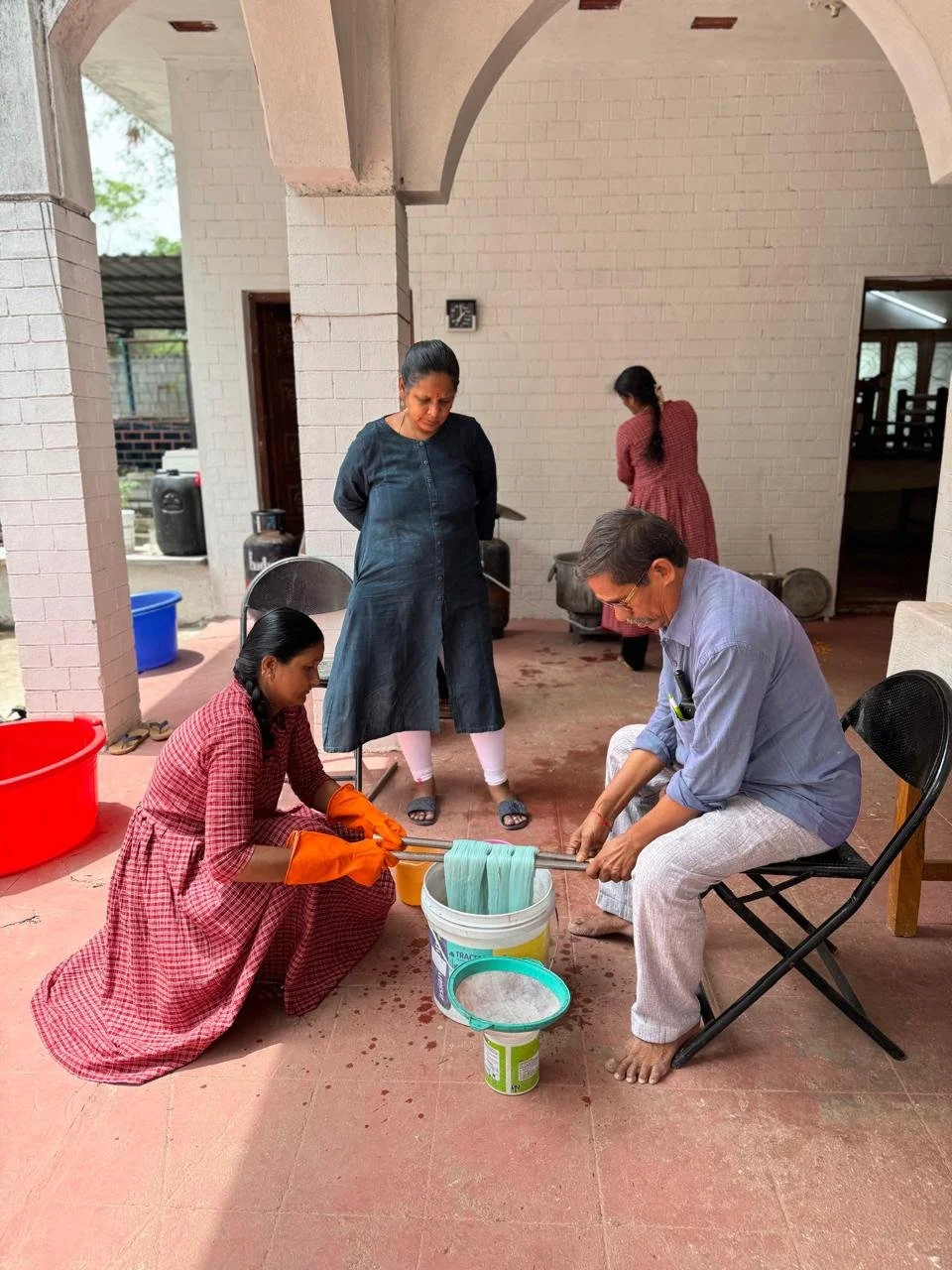
The Kalashala Natural Dyeing of Silk Workshop conducted by Smt. Jagada Rajappa on 25th June 2025 at Neeli Dye House, Rural Technology Park (RTP), NIRDPR, provided participants with a comprehensive introduction to the art and science of natural dyeing. The Kalashala Natural Dyeing of Silk Workshop was designed as a practical and lecture demonstration of natural dyeing processes on silk yarn for Kalamandir members and Handloom Futures research fellows as part of the Kalashala initiative.
The workshop emphasized critical processes including scouring, mordanting, dye extraction, dyeing, and colour fixing, highlighting how water quality, pH balance, and mordant type affect final colour results. Through a combination of demonstrations and practical exercises, participants explored dye extraction and application techniques on silk yarn using locally available natural materials such as turmeric, marigold, onion peel, pomegranate rind, sappan wood, katha, and indigo. The dyed yarn was dried before being over-dyed to produce diverse hues. By reviving traditional dyeing methods through modern scientific understanding, the program promoted sustainable textile practices and environmental responsibility.

-
To create spaces where weavers can display their knowledge, the Society for Welfare of Handloom and Handicraft Artisans, and the National Federation for Handloom and Handicrafts in collaboration with HFT organized handloom competitions held in Chirala, A.P, from 15-18 January 2021. Competitions were held in eight different categories of events that spanned skills such as weaving, winding, loom setting, and explicating.
This event was the first of its kind and saw an enthusiastic participation, especially by women. The prize money was equal to a month’s salary, in keeping with the seriousness of the competition. Representatives from Crafts Council of Andhra Pradesh, Chairman of Padmasali Sangham and the MLA for Chirala Constituency were also present.
communications | texts

publications
-
Schäfer, D., Mamidipudi, A., & Buning, M. (Eds.). (2023) Ownership of Knowledge: Beyond Intellectual Property. The MIT Press.
Valkenburg, G., Mamidipudi, A., Pandey, P., Bijker, W. (Eds.). (2019) Responsible innovation as empowering ways of knowing. Journal of Responsible Innovation. vol. 7 (1).
Menon, M. & Uzramma. A Frayed History: The Journey of Cotton in India. Oxford University Press, 2017.
Mamidipudi, Annapurna, and Wiebe E. Bijker, eds. Craft and Innovation—Proceedings of a Workshop—SHOT, India. Chennai:Kalakshetra Foundation, 2016.
-
Harlizius-Klück, E., Oak, V. S., & Mamidipudi, A. (2022). Conflicting threads: Technological innovation and the socio-technical ensemble of weaving. Technikgeschichte, 89(1), 35–62.
Mamidipudi, A., & Oak, V. S. (2022). The Crafts and Capitalism: Handloom Weaving Industry in Colonial India by Tirthankar Roy. Technology and Culture, 63(1), 259–261.
Mamidipudi, A. (2019). Crafting innovation, weaving sustainability: : Theorizing indian handloom weaving as sociotechnology. Comparative Studies of South Asia, Africa and the Middle East, 39(2), 241–248.
-
Mamidipudi, A. (2020, April 23). Indian weaving in the time of COVID-19. The PENELOPE Project.
Mamidipudi, A. (2019, June).Mamidipudi, A. (2019). The loom in the weaving marriage. Technology’s Stories.
Mamidipudi, A. (2018, December 6). Weaving marriages. The Voice of Fashion.
Mamidipudi, A. (2018, July 17). Counting on the body: Reflections on numeracy in Indian dyeing practices. The Recipes Project.
Mamidipudi, A. (2018, January 15). A recipe for crafting colour. Technosphere Magazine.
-
Harlizius-Klück, E., Fanfani, G., Mamidipudi, A., and McLean, A. (Eds.) HOMO TEXTOR. Weaving as (Technical) Mode of Existence.
Mamidipudi, A. (TBA) Monograph “The loom is one”: Making colour, cloth and epistemology”
Mamidipudi, A. Crafting household technologies in the 20th century. In A. Hommels & L. Heide (Eds.), The Bloomsbury Cultural History of Technology of the 20th century.
Harlizius-Klück, E., Mamidipudi, A. Reconstructing Knowledge in the Museum: Using the Handloom as Technology. In T. Boone (Ed.), Understanding Use. The Smithsonian Press.
field notes
Over the many decades of working with handloom artisans, Uzramma and her fellow traveler, Annapurna Mamidipudi recorded their interactions with the artisans through meticulously writing field notes. This kind of documentation was a way of building awareness, reflection, self-correction, and learning. As she went through a few of these documents that we recently retrieved from the archives, Uzramma found many gaps within each note such as tangential stories of the people mentioned, later developments and her own personal journey. Although we are aware that no complete documentation is possible (or desirable), writing field notes has become standard practice for HFT research fellows. The field notes offer an immediate record of a project or field visit as well as a valuable (re)source for later reflection on our work.
communications | videos
In Search of Kn/own/ables: Weaving a Handloom Knowledge Commons
In collaboration with the Kn/own/able project at the Max Planck Institute for the History of Science, Berlin that interrogates questions of knowledge ownership, research fellows of Handloom Futures produced this set of three short videos that document Malkha’s material decolonizations. The first video documents how the shift to organically grown non-GMO varieties of cotton inspired farmers, spinners and weavers to work collectively as well as exhibit their individual knowledge to produce over 60 density variation designs of unbleached Kora cotton cloth (a collection of textiles called Sonthanga). The second video documents how spinning at a decentralised scale allowed spinning operators of Pulugurtha Handloom Cooperative Society to produce yarns of different counts and twist from cotton varieties that elude textile industry standards. The third video documents the sharing of knowledge between K. Narasimhalu - a master weaver of tie and dye ikat, Odelu Vurugonda - a master dyer of natural dyes and Thangallapalli weavers, warpers and winders who’ve worked with Malkha yarn for two decades to produce unique natural dyed Malkha ikat textiles. As part of the search for existing examples of knownables – where knowledge and its ownership are not split - the videos along with their corresponding textiles document Malkha’s efforts to weave a Handloom Knowledge Commons where the knowledge is produced and owned collectively while simultaneously acknowledging each individual artisan’s ownership of knowledge.
Learn more about the kn/own/able project and Malkha
learn more about the making of the video:
SALOO | music video
Shah Hussain, the 16th century weaver poet from Punjab, describes Saloo (a wedding shawl) that adorns a new bride and how in wearing it, the journey of life is woven into it. Inspired by the song, Radhika Sood Nayak accompanied fellows of Handloom Futures to meet various artisans of Bhuj, Gujarat.
learn more about making the film:
Ulatbansi/zigzagging | Research Film
How to speak without words?
How to follow zigzags of the shuttle?
How to tune a loom?
How to seek the teacher inside yourself?
Weaving is known but not spoken. Kabir, the weaver/poet/saint from the 15th century turned language on its head, to point to this impossibility of speaking weaving, which he also connected to the search for the spiritual within oneself. This film zig zags between the weaving and musical practice of weavers in Kachchh, Gujarat, and the one lone weaver in Chirala, Andhra Pradesh, who holds the memory of a time before the Jacquard loom robbed them of the language of handloom.
From the sky hangs the thread!
Kabir
To know more about the Penelope Project:
In collaboration with the ERC funded research project PENELOPE hosted at the Deutsches Museum, Munich on weaving and mathematics in Ancient Greece, Handloom Futures held a workshop in August 2023 on the algorithm of the famous meander pattern from ancient Greece. To showcase the cloth as a research product, Ellen Harlizius Kluck, the Principal Investigator of PENELOPE asked weavers Odelu Vurugonda and Dharmender Vaddepalli to weave fabric that contained the meander pattern as well as its algorithm. In this video, Handloom Futures fellows documented the weavers construct a 12 pedal frame loom to weave this research product in the weaving village of Jangaon. During the workshop, participants also learned tablet weaving, an ancient Greek technique, and experimented with the vertical warp weighted loom. This video field note is meant to be accompanied by the actual meander textile authored by Odelu.
communications | podcasts
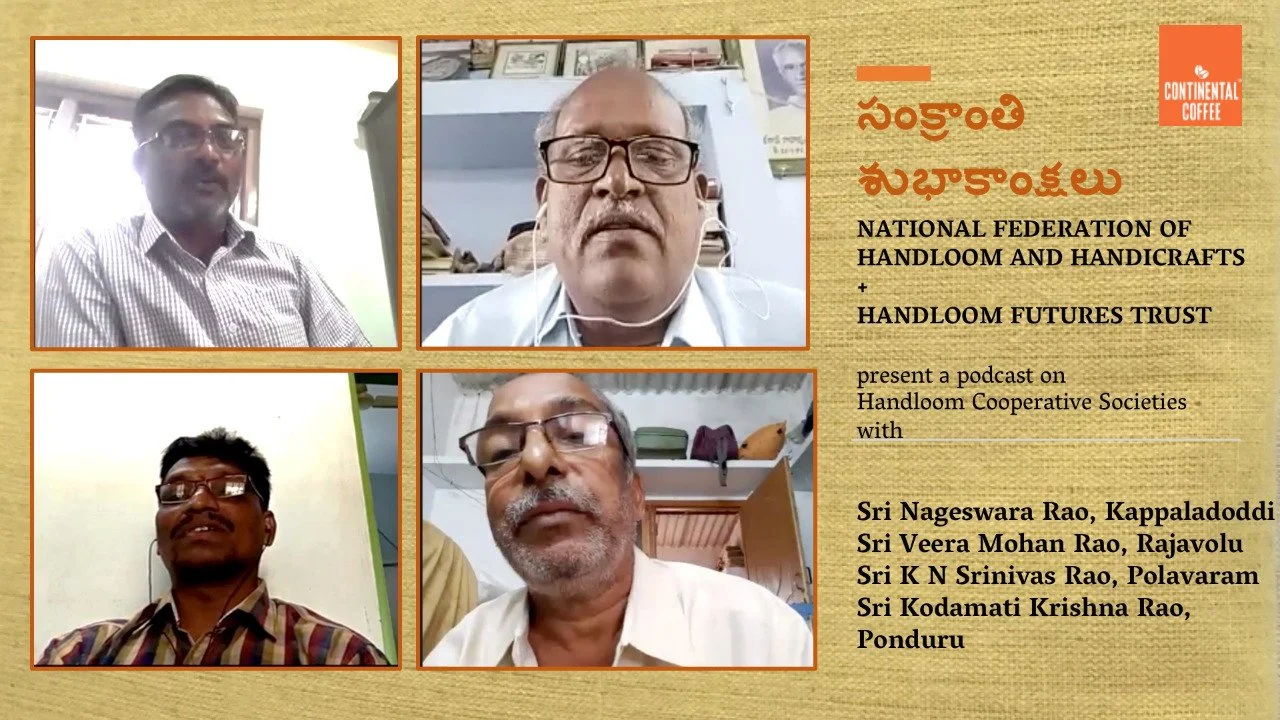
During the pandemic, a group of us, including weaver cooperative members, union leaders, textile designers, handloom advocacy groups and academics got together via zoom to discuss the pressing issues that attend handloom in India today. These meetings also became a space to share stories, exchange insights and reflect on our varied handloom journeys. Handloom Futures Trust thought it would be useful to structure some of these dialogues together in the form of a podcast. To begin with, we thought we’d put out an audio snippet as a tribute to handloom cooperatives. We thought it would make for an auspicious beginning to publish it on Markar Sankrantri (the harvest festival) on14th January 2021.
encounters | installations

-
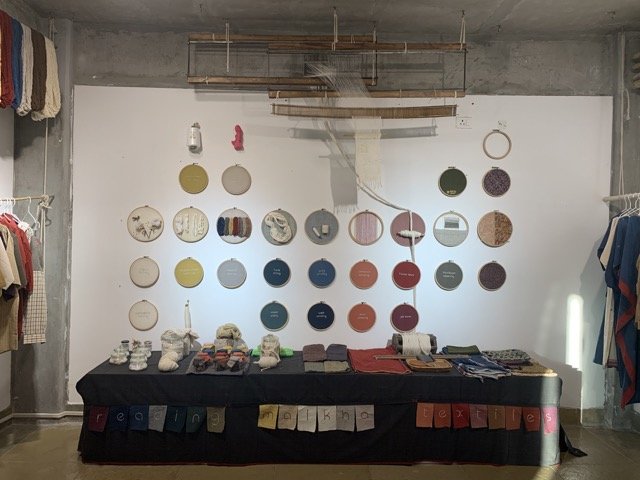
When HFT fellows were invited in May 2022, to be a part of a working group to examine Responsible Documentation and Conscious Outcomes at the Max Planck Institute for the History of Science, Berlin, they presented themselves as human archives. The human archives allowed the fellows to make their work visible and made it possible for the international group of scholars and artisans to engage from their own practices. The human archives successfully demonstrated that the cotton, yarn, cloth and tools could also be read as documents or records of the interaction between the researcher, the artisan and natural materials.
-
HFT fellows curated a material archive of the Malkha. They identified what made Malkha textiles different at each stage – the locally grown organic cotton, the decentralised spinning of unbaled lint, natural dyeing of yarn, specific ways of sizing yarn, the skillful winding of different yarn counts, different warping methods, the use of jowar (millet plant) reed instead of a steel reed, the weaving of iconic patterns and the hand block printing techniques. Using embroidery hoops, Malkha cloth, the end ‘products’ of each stage and Malkha yarn to embroider the text, they charted out the entire process and displayed it on a wall in the Malkha space. They also collected the raw materials, tools and sample cloth to encourage a ‘reading’ of the skill and knowledge that goes into the creation Malkha textiles. A small working loom, warping and winding tools were also installed so that anyone can learn and practice weaving. Putting together this material archive makes it possible for artisans and members of Malkha to speak about their work to the non-handloom world.

-
To address the problem of gaps in documentation, a media criticism workshop was conducted with Malkha team members and dyers. The various indigo films were screened and the problem of non-dyers recording the dyeing process was addressed. The indigo symposium was postponed due to the pandemic and more tragically,Malkha’s master dyer, Mohammed Salim Pasha, passed away in 2022. Salim was a living archive of indigo and natural dyeing and what remains are the memories of our exchanges with him, the yarn he dyed and the knowledge that he shared with his fellow dyers.
encounters | material interfaces

-
To further the idea of the knowledge commons, HFT fellow Odelu lead a team that designed and built a compact loom (built out of recycled wood with inbuilt weft and warp winding attachments) that is now a permanent part of the Malkha space. Visitors are encouraged to try their hand at it to get a glimpse of this technology and to better appreciate the possibilities inherent in it.

-
This installation helps visitors to begin reading textiles and go beyond the labels in understanding fabric. An experiment in building material literacy, this installation aims to break the dichotomy of products and processes, by helping people to deepen their material understanding of the construction of cotton textiles. Further it showcases the design abilities of weavers who are otherwise seen as passive implementers of the ideas of professional designers.

-
Evolving the Neeli Malkha Dyehouse at the National Institute of Rural Development, as a knowledge centre is an attempt to grasp what possibilities natural dyeing offers the world today.
For dyers who tell colour through smell, memory and song, natural dyeing knowledge is not only to be spoken of, but to be smelt, remembered and sung of, if it is to be shared. Through sensorial body this craft is known as laboratory experiments, as sacred ritual, as socio-technical - material processes, and as raaga.